I have been reading about the psychology behind restorative practices (see yesterday's post). It's all fascinating stuff but I was particularly intrigued by the work of Donald Nathanson on shame. He states (after extensive research) that unlike many other emotions, e.g. anger, fear, disgust, surprise (described as a wipe-clean of the brain so you just focus on what's there in front of you), interest, enjoyment, etc, shame does not have any chemical or electric biological triggers when it is experienced. Although he admitted it might seem puzzling to some, he described shame, therefore as being simply the reaction to an interruption of a positive feeling or affect.He saw that shame in his own children usually manifested in their turning their heads downwards and averting their eyes and that they also did this when a pleasurable or interesting experience was interrupted. This demonstrated that shame was not just felt when you did something wrong; it was also felt when a good thing was interrupted. This also explains why victims of wrong doings can also feel shame - as their positive experience has been interrupted. I found this interesting, and like he predicted, it took me a while to 'feel' that this absence of reaction was a possibility.
Then I did think of an example where I felt shame through the absence of positive affect. When I was a student teacher, the primary maths lecturer took us through how best to help children really understand the different numerical processes other than through using routine algorhythms. I actually enjoyed what he was teaching (the nerd in me). It was subtraction one week and we were discussing how you could help children to 'see' that when you subtract a negative number, you in effect add. I suggested that if you take away a negative thing like a hole, you in effect add something. I was enjoying my idea but he told me that answer was 'too contrived' and he carried on. Although I had done nothing wrong, his response stopped me enjoying the debate and all I can describe is that I felt shame! I remember wondering why I had felt that at the time. This chap's description of a break in positive feeling rang true.
Donald Nathanson then went on to describe four different responses to shame.
• Attack other - blaming others for what they have done and lashing out at them
• Attack self - where people self reprimandnad blame themselves e.g. "I am so stupid"
• Avoidance- where a person side-steps away from the shame by making jokes or using other distractions. Some of these distractions can be quite damaging such as alcohol abuse.
• Withdrawal - the run and hide response.
I suspect there are gender biases with some of these but he states that 'attack other' and 'avoidance' are the most common responses in our society. The responses can of course also vary in intensity - from full on to very mild.
I would guess every individual has a default reaction to shame and becoming aware of this can help our behaviour be managed. If shame is simply an interruption of positive experience, we probably all feel it pretty regularly!
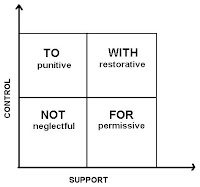
N.B. I read far more explanation than I have written but the justification of exploring shame in terms if restorative practice is that RP manages shame and negative feelings and leaves an outcome of positive feelings unlike punishment. The relunctance to destroy the positive feeling created by restorative practices means repeat 'crimes' can become less likely for some individuals.